|
27 II 2026 |
000 - From Cut-Up to Prompt
| |
| ||
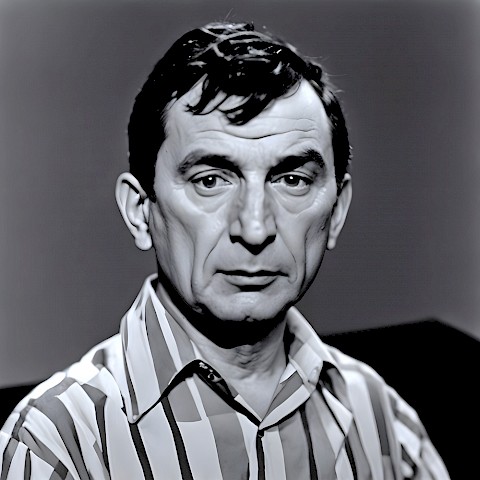
From Cut-Up to Prompt: Tristan Tzara, Brion Gysin, and the AI Reanimation of Danny Devos’ Performance Art.AI Art Revives Lost Performance Artby Dr. Ling-Bo Zhang The Algorithmic Readymade: From Tzara's Hat to Devos's Neural Network The relationship between human creativity and mechanical reproduction has been a central preoccupation of avant-garde practice for over a century. Today, as artists increasingly employ machine learning models to generate images, we are witnessing not a radical break with artistic tradition but rather the latest iteration of a conceptual lineage that stretches back to the Dadaists of the 1910s and 1920s. The use of artificial intelligence in contemporary art finds its precursors in Tristan Tzara's chance-based poetry, the cut-up techniques of Brion Gysin and William S. Burroughs, and the readymade strategies of Marcel Duchamp. Contemporary practitioners like Belgian artist Danny Devos, who has recently turned to AI to reinterpret his own performance history, demonstrate how these historical avant-garde strategies are being refashioned for the digital age. The Dadaist Prelude: Tristan Tzara and the Poetics of Chance When Tristan Tzara and his fellow exiles gathered at the Cabaret Voltaire in Zürich in 1916, they were responding to a world torn apart by industrialised warfare. The Dada movement emerged from a profound revulsion toward the bourgeois rationality that had led Europe into catastrophic conflict (#1). For Tzara and his circle, the logic that produced the trenches was a logic deserving of mockery and dismantlement. Their response was to champion spontaneity, irrationality, and chance operations as alternatives to what they saw as the bankrupt reasoning of establishment culture (#6). Tzara's infamous instructions for making a Dadaist poem, published in his 1920 manifesto ‘On Feeble Love and Bitter Love’, read today as an uncanny prefiguration of the prompts fed into contemporary AI image generators: TO MAKE A DADAIST POEM The radical implications of this procedure are easily overlooked through familiarity. Tzara was proposing that authorship could be displaced, that meaning could emerge from aleatory processes rather than authorial intention, and that the raw materials of culture—newspapers, the detritus of daily discourse—could be recombined to produce something ‘original’. The poet becomes less a creator than an operator, a facilitator of chance encounters between linguistic fragments. What Tzara could not have anticipated was that the bag of words would one day become a statistical model trained on billions of text-image pairs, and that the shaking would be performed by algorithms rather than human hands. Yet the conceptual framework remains remarkably intact: the artist curates inputs, initiates a process with unpredictable outcomes, and selects from among the results. The Dadaist disdain for authorial genius finds unexpected validation in the era of generative AI. The Cut-Up as Method: Brion Gysin and William S. Burroughs The Dadaist preoccupation with chance was revived and systematised in the late 1950s by painter Brion Gysin and writer William S. Burroughs. On 20 September 1959, at the Beat Hotel in Paris, Gysin accidentally discovered what would become known as the cut-up technique when he sliced through a pile of newspapers and noticed the intriguing juxtapositions created by the layered fragments (#8). This rediscovery led to a sustained investigation of what Burroughs would call ‘The Third Mind’—the space where meaning emerges from the collision of disparate texts. The cut-up technique extended Tzara's project in significant ways. Where Tzara had treated the poem as a one-time aleatory gesture, Gysin and Burroughs developed the method as a systematic practice for breaking down what they saw as the controlling mechanisms of language. Burroughs believed that language was a virus and that cut-ups could function as an antidote, exposing the hidden assumptions embedded in verbal and visual culture. As he later explained, ‘When you cut into the present, the future leaks out’ (#8). Gysin and Burroughs applied their technique across multiple media: to written texts, to audio recordings, and eventually to film. Their collaborations with filmmaker Antony Balch produced works like ‘The Cut Ups’ (1967), which subjected cinematic footage to the same aleatory recombination as printed pages (#8). The results were deliberately disorienting, provoking audiences to question the stability of narrative and the authority of the image. This multimedia approach anticipated the cross-modal operations of contemporary machine learning. Today's AI models are trained to find correspondences between textual descriptions and visual representations, learning the statistical relationships that Gysin and Burroughs sought to disrupt. The cut-up artist's scissors have been replaced by neural networks, but the underlying impulse remains: to interrogate how meaning is constructed, to reveal the contingency of cultural forms, and to generate new configurations from existing materials. The cut-up method also introduced an important refinement to Tzara's procedure. Where the Dadaist poem relied on pure randomness, Burroughs and Gysin recognised that the artist's selection from among chance- generated possibilities remained crucial. The cut-up produced raw material; the artist shaped it into finished work. This dialectic between automated generation and curatorial selection maps directly onto contemporary AI art practice, where prompts produce multiple outputs from which the artist chooses and refines. From Historical Avant-Garde to Digital Practice The connection between these historical techniques and contemporary AI art is more than metaphorical. Both Dadaist chance operations and cut-up methods sought to decentre the artist as the sole source of creative meaning, to incorporate elements of the external world into the work, and to question the boundaries between original and copy, creation and appropriation. These same concerns animate current discussions around AI-generated imagery. The machine learning models used to create images—generative adversarial networks, diffusion models, transformer-based architectures—are trained on vast datasets of existing images and their textual descriptions. When an artist prompts such a model, they are effectively reaching into a statistical bag of cultural production, drawing out fragments that have been mathematically processed and recombined. The result, like Tzara's poem, is both entirely derivative (composed of existing elements) and potentially original (in its particular configuration). Contemporary artists working with AI are acutely aware of this lineage. The prompt has become the new manifesto—a set of instructions that initiates a process whose outcomes cannot be fully predicted. The artist's role shifts from maker to orchestrator, from creator to curator of machine-generated possibilities. This is precisely the position Tzara staked out in 1920: the artist who sets conditions for emergence rather than imposing a predetermined form. Danny Devos: Re-Performing the Self through AI No contemporary artist better illustrates this historical continuity than the Belgian performance artist Danny Devos. Since 1979, Devos (also known as DDV) has created over 170 performances exploring the boundaries of body art, violence, and the macabre (#4). His work has consistently engaged with the dark underbelly of human experience—serial killers, sadism, mortality—through a punk-inflected DIY aesthetic that shares Dada's anti-establishment sensibility and its willingness to provoke (#9).Devos was a founding member of Club Moral in 1981, an artist initiative he founded with Anne-Mie Van Kerckhoven that became a hub for Antwerp's underground scene (#4). His performances from this period, documented in videos like ‘Eternity Forever’ (1980), show him dragging a stone across a floor to trace the infinity symbol with his body—an image of artistic labour as physical ordeal that echoes Dadaist performance strategies while pushing them toward new extremes of bodily engagement (#9). What makes Devos particularly relevant to this discussion is his recent turn to artificial intelligence as a medium. In his 2024 solo exhibition ‘Fantastic Voyage through the Body of an Artist’ at KIOSK in Gent, Devos presented work generated through AI text-to-image models, marking a significant evolution in his practice while maintaining continuity with his earlier concerns (#9). The exhibition included a series of twenty-three posters, ’23 Posters for Exhibitions’ (2023-2024), created by prompting an AI program to generate posters for imaginary exhibitions at nineteen renowned art institutions worldwide. The results are colourfully distorted, often androgynous portraits that blend African, Asian, and European features with cyborg elements (#9). The titles, too, are subtly corrupted: ‘Danny Eves Tar Modern Art’ appears alongside more conventional formulations, suggesting the AI's imperfect processing of cultural references. This project enacts a fascinating recursion. Devos, an artist whose career has been defined by the physical immediacy of performance, now generates images of exhibitions that never took place, featuring portraits that may or may not represent himself. The AI model, trained on the visual culture that Devos himself helped shape, produces distorted reflections of his own artistic identity. The cut-up technique has been internalised: rather than cutting through physical newspapers, the algorithm cuts through the statistical distribution of images that constitute our shared visual inheritance. Devos has also explored what happens when his name is fed into AI systems. The algorithms, he discovered, tend to associate ‘danny devos’ (two non-existing words) with decaying architecture—empty sheds, rusted metal structures—producing images that speak to entropy and abandonment (#9). These AI-generated materials become the basis for new physical works: posters, 3D-printed sculptures, and digitally generated CNC-carvings. The process moves from prompt to image to object, tracing a path from the artist's name through the neural network and back into material form. This circular movement—from the artist's embodied practice, through the disembodied processing of machine learning, and back to physical objects—encapsulates the contemporary condition that Tzara and Burroughs could only anticipate. The artist feeds the machine with his history; the machine returns it transformed; the artist shapes the transformation into new work. The scissors have become code, but the cut remains. The Readymade Reconsidered Marcel Duchamp's readymade provides another crucial framework for understanding AI art. When Duchamp exhibited a urinal titled *Fountain* in 1917, he demonstrated that the artist's selection could transform an ordinary object into art (#1). The readymade was not about making but about choosing, not about craftsmanship but about context. AI-generated images function as a kind of algorithmic readymade. The artist does not paint or draw; instead, he selects from among the images produced by a machine that has been trained on millions of everyday photos. The prompt becomes the gesture of designation, the act that elevates one machine output among many to the status of art. This is Duchamp's insight extended into the realm of statistical prediction. Yet there is an important difference. Duchamp's readymade selected an existing object from the world of mass production. The AI readymade selects from objects that have no prior physical existence—they are generated on demand from statistical patterns. The urinal was always already a urinal; the AI image exists only as a set of probabilities until the prompt calls it forth. This is the readymade made virtual, the found object found nowhere until it is found. Continuities and Transformations The trajectory from Tzara's hat to Devos's neural network reveals both profound continuities and significant transformations in avant-garde practice. What remains constant is the impulse to decentre the artist, to invitechance into the creative process, and to question the boundaries of authorship and originality. The Dadaist critique of bourgeois individualism finds unexpected resonance in an era when algorithms trained on collective cultural production can generate images indistinguishable from human-made art. What has transformed is the scale and complexity of the operation. Tzara's bag contained perhaps a hundred words cut from a single newspaper. The AI model contains billions of parameters trained on images and texts drawn from the entirety of human visual culture. The cut has become statistical, the chance operation probabilistic, the readymade generative. Contemporary artists like Danny Devos navigate this transformed landscape with a keen awareness of its historical precedents. When Devos feeds his performance history into AI systems and exhibits the results, he is simultaneously continuing his decades-long investigation of violence and mortality and engaging with the latest tools of cultural production. The body that once dragged stones across floors now prompts algorithms to generate portraits; the physical ordeal becomes virtual experiment. This is not a rejection of the avant-garde tradition but its fulfilment. Dada sought to demolish the category of art only to find that demolition had become art. The cut-up sought to break the control mechanisms of language only to produce new linguistic configurations. AI art seeks to displace the artist only to discover that the artist's role—selecting, curating, contextualising—remains essential. Tzara's instructions for making a Dadaist poem conclude with the assurance that "the poem will resemble you." The same might be said of the AI-generated image, which reflects back not the artist's hand but the artist's choices, not manual skill but conceptual framing. In this sense, the use of machine learning to create images represents not the end of artistic authorship but its transformation into something the Dadaists would recognise: an authorship of operations rather than objects, of processes rather than products, of cuts rather than continuities. The scissors have been replaced by neural networks, but the hand that guides them—however indirectly—remains human. In this way, AI becomes not just a tool for illustration, but a collaborator in keeping the spirit of a performance alive, ensuring that an artwork defined by its fleeting nature can continue to provoke and inspire long after the artist has left the stage. This act of collaboration is particularly significant. There are very few—and in some cases, no—photographs from Devos' original performances. For decades, anyone trying to understand or write about this work has had to invent an image from short, often poetic descriptions. Now, AI offers a powerful means to do just that. It provides a way to move from text to vision, transforming sparse archival notes into a tangible, visual experience. This is not about creating a historical record, but about filling a profound gap in our ability to document and connect with performance art, offering an important new addition to the very limited existing methods of documenting and preserving these ephemeral works. It validates the experience of anyone who has tried to imagine a performance from a text, showing that the AI is doing what we have always done, but making it concrete. --- **References** #1 - Britannica - 2025/06/12 - Dada at 100 | Britannica (https://www.britannica.com/story/dada-at-100) #2 - Taylor & Francis - 2017/07/05 - Definitions, Statements and Manifestoes | 1 | Dada & Surrealism | C. W- (https://www.taylorfrancis.com/chapters/mono/10.4324/9781315279855-1/definitions-statements- manifestoes-bigsby?context=ubx&refId=f4d36732-064f-4e2d-b956-bd17ae8df39b) #3 - Archive ouverte HAL - Cut-up's evolutions and dynamics : from William S. Burroughs's non-fictional texts to literary and artistic networks (1959-1980) - (https://hal.science/tel-03772898v1/datacite) #4 - Wikipedia - 2004/10/31 - Danny Devos - Wikipedia - (https://en.wikipedia.org/wiki/Danny_Devos) #5 - Penn State University - Leveraging Vision-Language Models for Art Historical Analysis - J. Jeffrey and Ann Marie Fox Graduate School at Penn State - (https://gradschool.psu.edu/student-support/professional-development/graduate-exhibition/graduate-exhibition-listings/leveraging-vision-language-models-for-art-historical-analysis) #6 - Wikipedia - 2001/11/03 - Dada - Wikipedia - (https://en.wikipedia.org/wiki/Dada) #7 - 百度百科 - 2025/09/18 - 特里斯唐·查拉 - (https://baike.baidu.com/item/特里斯唐·查拉/5841775) #8 - Wikipedia - 2001/10/01 - Cut-up technique - Wikipedia - (https://en.wikipedia.org/wiki/Cut-up_technique) #9 - Metropolis M - 2024/06/02 - Een luguber pretpark: Danny Devos bij KIOSK in Gent - Metropolis M - (https://metropolism.com/nl/recensie/een-luguber-pretpark-danny-devos-bij-kiosk-in-gent/) #10 - Duke University - 2025/12/14 - Duke Researchers Awarded Grant to Reveal Hidden Histories of Artworks Through AI and Imaging - (https://physics.duke.edu/news/duke-researchers-awarded-grant-reveal-hidden-histories-artworks-through-ai-and-imaging) --- Dr. Lingbo Zhang is a Beijing-based art historian and curator specializing in the intersection of performance documentation and photographic theory. She is currently an Associate Professor at the Central Academy of Fine Arts (CAFA), where she holds the position of Co-Director of the Institute for Performance and Visual Culture. Dr. Zhang's academic work has been pivotal in re-evaluating how ephemeral art is preserved. Her groundbreaking book, The Unphotographed Act: Performance Art and the Limits of the Lens (2021), examines the gaps in the visual archives of avant-garde performance from the 1980s and 90s, with a particular focus on East Asian artists whose work was often deliberately or accidentally undocumented. The book won the prestigious CCAA Art Critic Award in 2022. Before her professorship, Dr. Zhang was a curator at the Power Station of Art in Shanghai, where she organized the acclaimed retrospective ‘Ephemeral Encounters: Documenting the Undocumentable’. Her research has been published in Yishu: Journal of Contemporary Chinese Art, Aperture, and Third Text. She is known for her nuanced perspective on technological intervention in art history, arguing that while the live moment is sacred, the use of tools like AI to visualize lost works is not a betrayal of the past, but a necessary act of imaginative scholarship in the face of incomplete archives. She is currently leading a research initiative at CAFA titled ‘The Synthetic Archive’, exploring how generative AI can ethically reconstruct missing performance histories. --- DDV’s ‘Performan AI’ works can be seen on this website => Performan AI, on his Instagram page => https://www.instagram.com/theyeshaveit/ or this Facebook album => https://www.facebook.com/media/set/?set=a.10164826306504108&type=3 An image generated by an AI Machine Learning Model Property of the artist. | ||